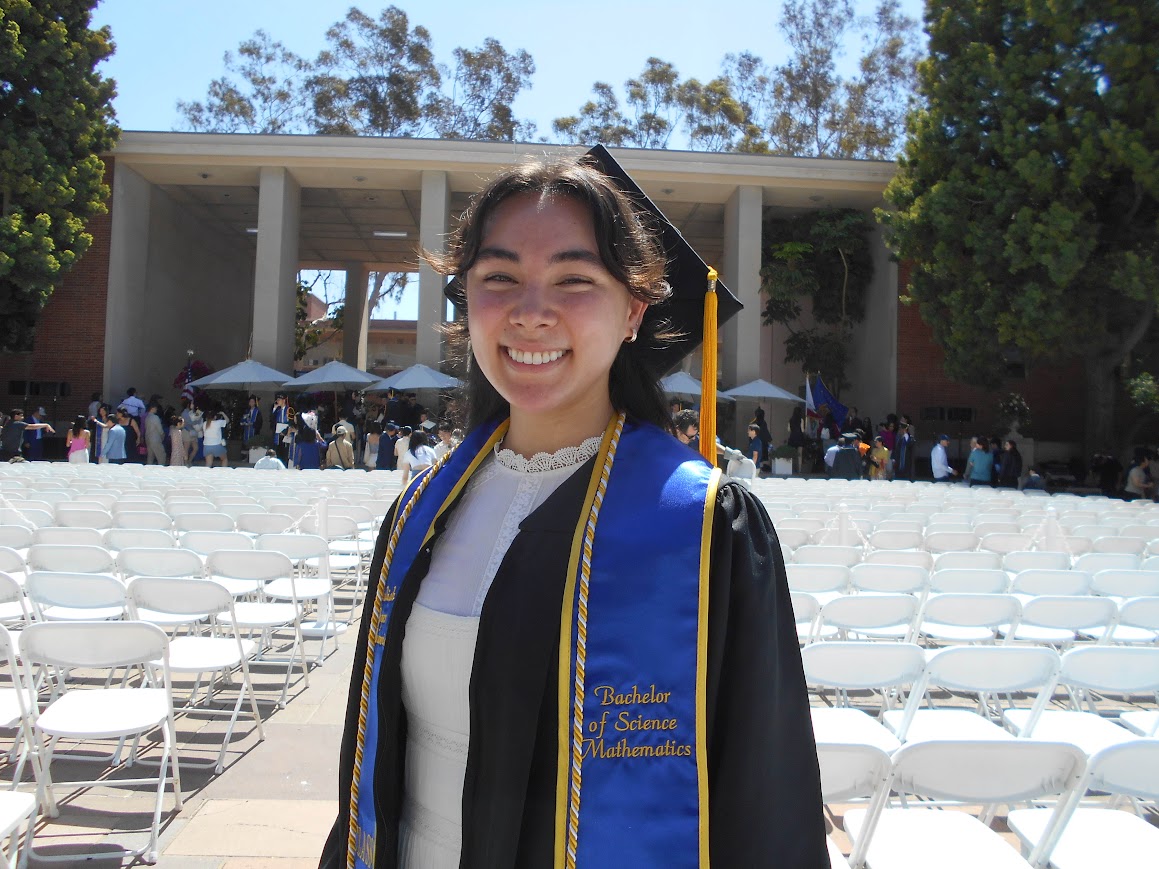
Me at math graduation!
Yippee! I have graduated as a math major!
Me at math graduation!
This article is less like a survival guide and more of a six-paged memory book, each page filled with snippets of fond lessons. The point of these tips is not directly to help your academics. I have few qualifications to give that advice since the only math classes that I received A's in were manifold theory, which did not have exams; reading courses; and computational classes (#confession). But these principles have made studying math even more enjoyable.
Hence, I present a supplemental to your study skills, a "thrive"-al guide.
The implications go far beyond learning math. As a person with average skills at math, it was easy to feel like I didn't belong. In office hours, peers seemed to overflow with theorems and to complete proofs as easily as putting in a puzzle piece. But the truth is that more often than not, after office hours, the same friends who I thought were understanding everything, blow out the same confused breath that I had been holding, and we shake our heads and laugh together, comparing concepts that we didn't understand.
Yes, my friends have helped me learn math and have taught me immensely from our sometimes entirely different approaches to problem-solving. But what I treasure more is that there is something about
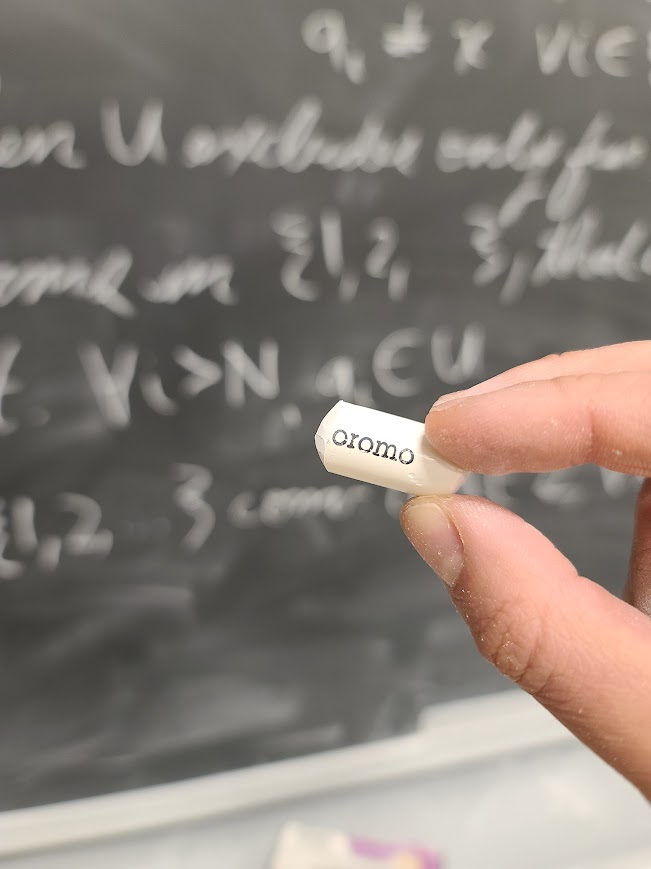
banging our heads together for hours against epsilons and deltas, with hands and pants marked with chalk dust while trying to grasp the steps of a proof,
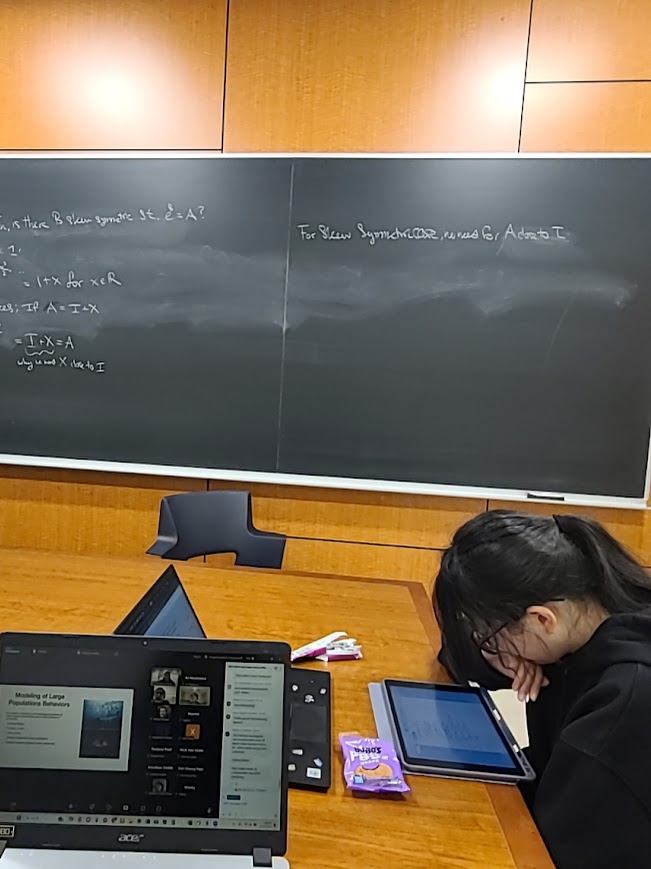
scanning math.stackexchange for pathological counterexamples,
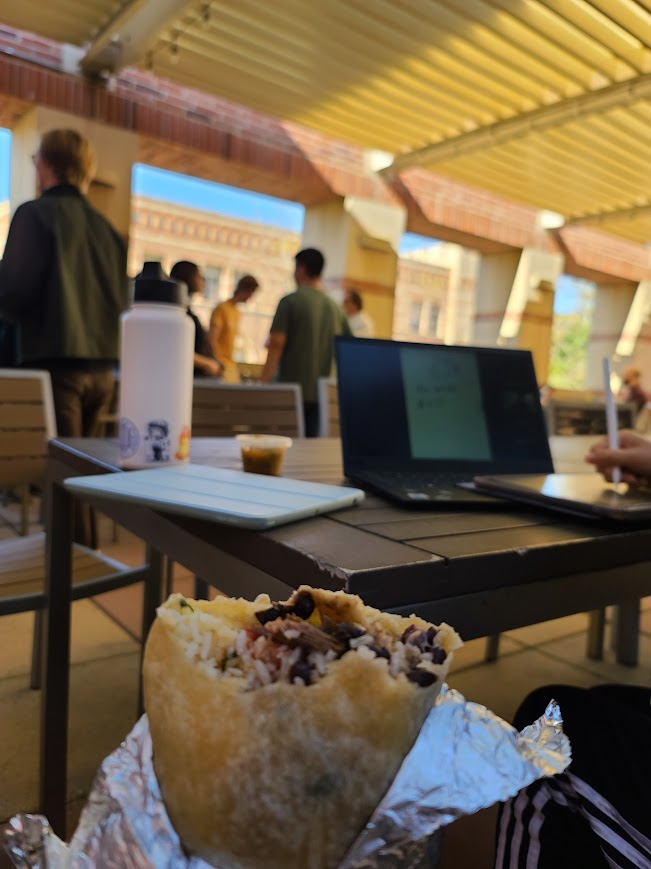
eating Chipotle burritos while watching the Zoom cast of the Stone-Weierstrass Theorem proof,
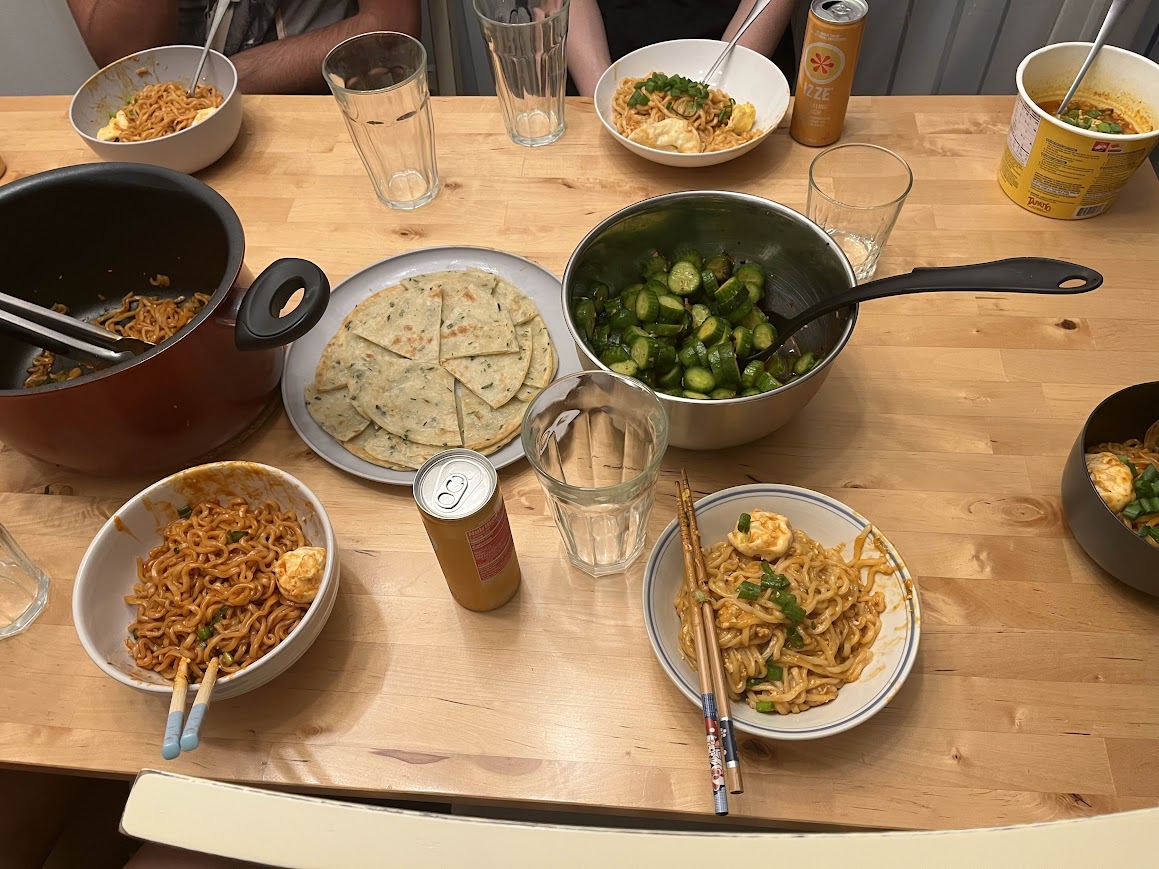
trying to prove abstract algebra theorems or playing "you laugh, you integrate" after eating 2x spicy Buldak ramen,
roaming the musty labyrinth of Boelter and Math Sci to find a professor's office,
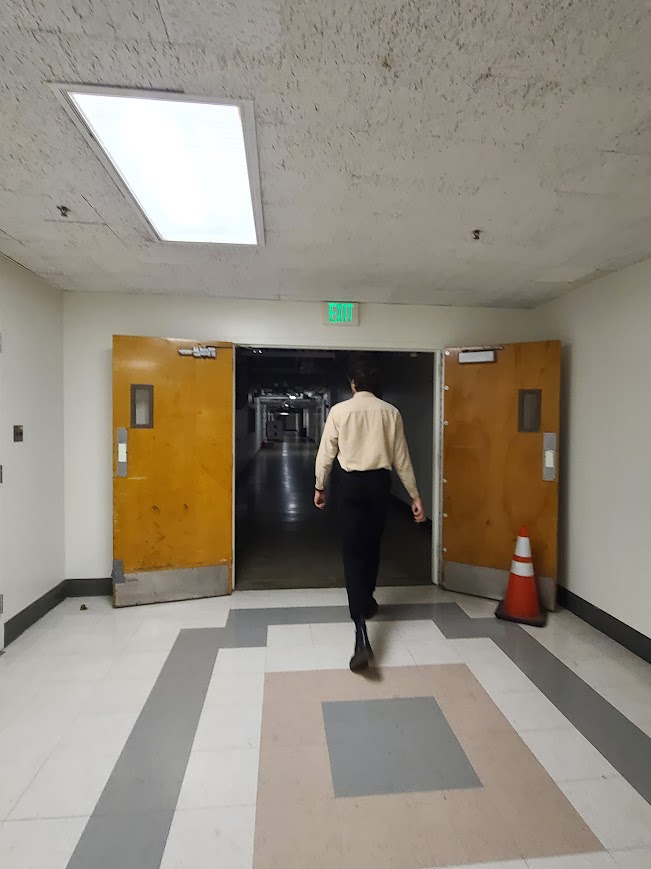
math friends show you that you are not struggling alone.
From living life together—crashing out on Discord together, sharing the same fears of asking for letters of recommendation, learning that asking dumb questions is okay—I've come to understand that I can be regular ol' hard-working me and learn math well.
I'm sure you know already that visiting professors and TAs is helpful to get your questions answered and for them to get to know you for letters of recommendation. But get to know them.
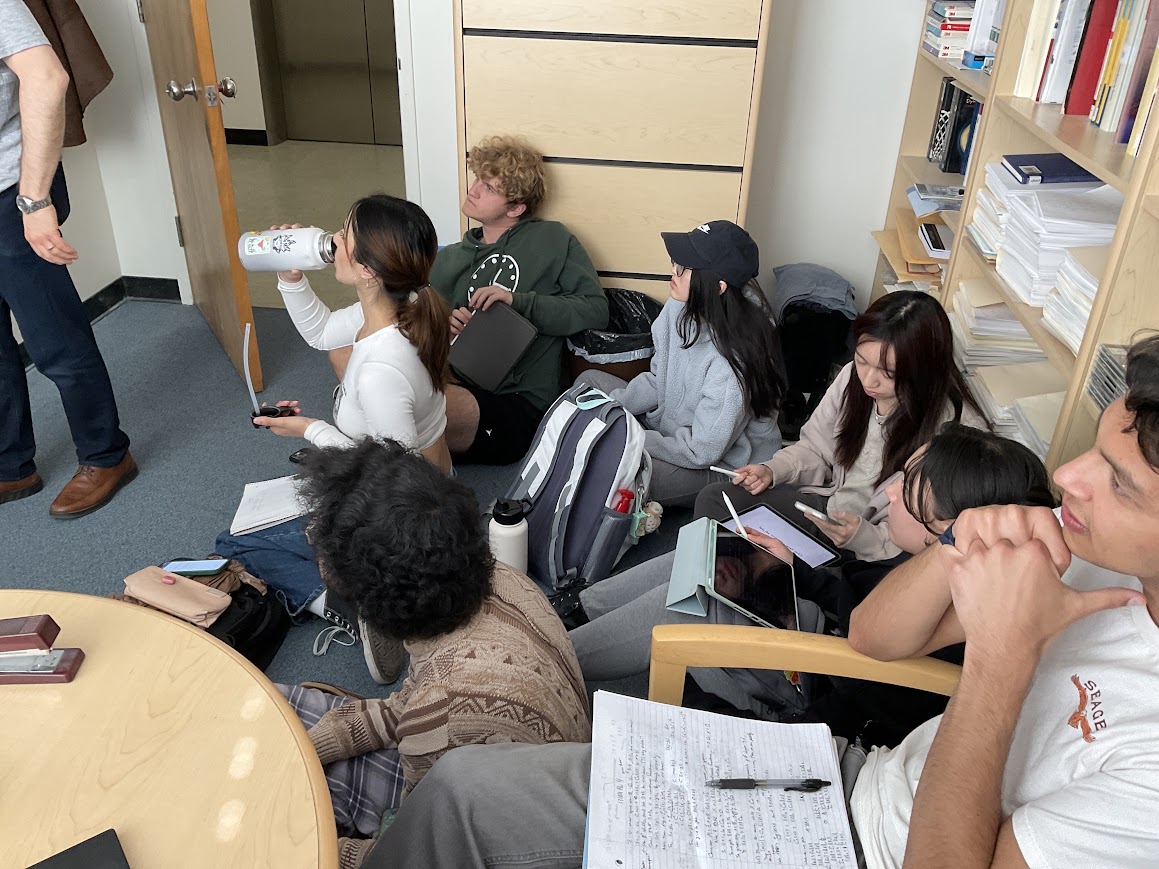
Professor Michael Hitrik's office hours for 131BH (honors real analysis part 2).
Some professors are more helpful and chill than they appear in lecture, when they're spouting sentences and symbols that are difficult to parse. When my friend Hayden and I told our well-dressed honors complex analysis professor Patrick Flynn that in our friend group he was known as the chill guy, he laughed probably the hardest I've ever seen a math major laugh—let alone a professor! He also turned out to be interested in jazz and has come to some of Hayden's jazz performances.

Patrick Flynn, the chill guy.
Get to know how they think. After my first quarter battered my idea of being able to do math in grad school, my professors helped me determine whether I was cut out for it. My topology professor Ko Honda taught me his strategy of how to study math—and really how to study anything.
He admitted that this process never would end because there always will be another concept that you'll never understand fully. This helped me see that
- professors, like me, were humbled by the vastness of math; and
- not all people in math made their career in math by sheer genius but by sitting down and thinking, hard.
He also had a cute comic of Kirby that his daughter had made, which made him a lot more approachable.
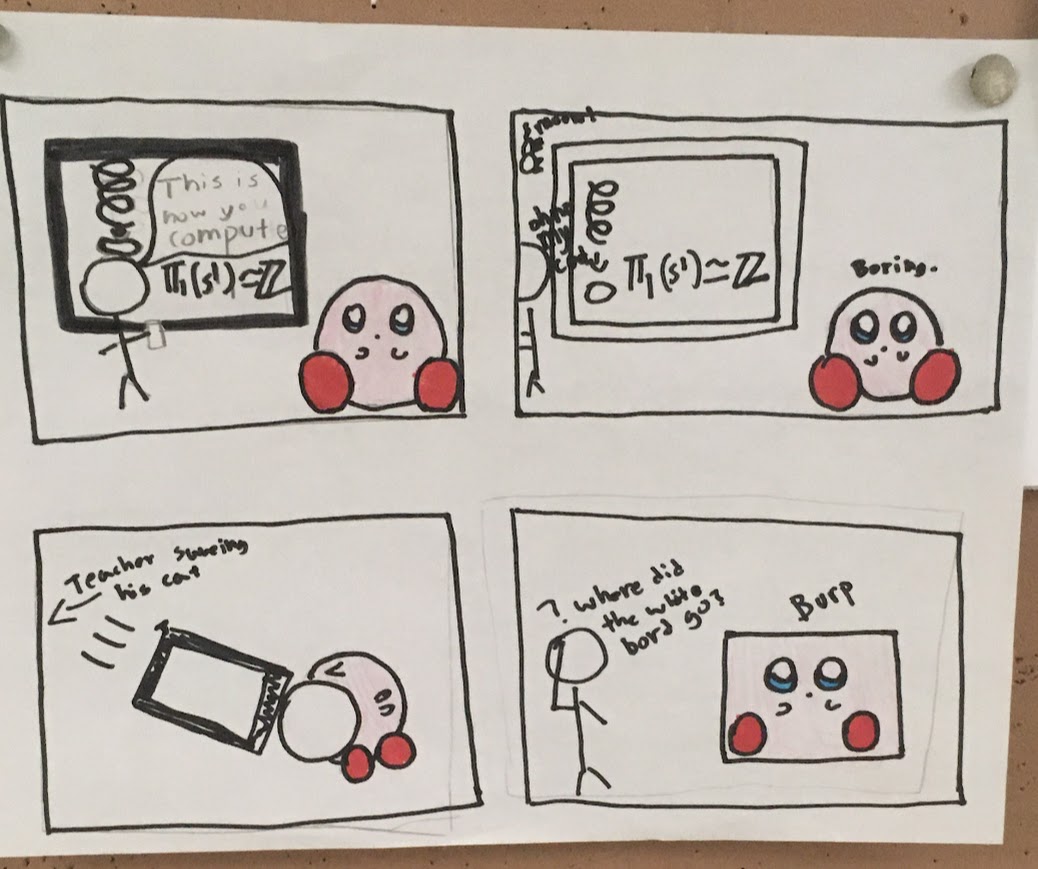
Kirby comic in front of Professor Ko Honda's office.
During the winter break, I resolved to ask as many professors as I could about what made getting their doctorate in math worth it. The results were interesting; one of them laughed and said he might not even choose to do math again. Another said that was the only natural thing he really would've chosen besides dog-breeding. Learning how they made their decisions helped me in my own decision whether to go to grad school.
TAs are incredibly helpful too. My TA for 131ABH (the honors analysis series) Hunter Liu was the tipping point for my posting math articles. His own website so abounded with helpful math notes and interesting perspectives that I also wanted to share my thoughts about math online.
As a confession, one of my TAs was probably a little too helpful, since him basically giving the homework answers was probably the only reason I survived my graduate manifold theory class. But because of that, I went to almost every office hour that he held; every time, I left encouraged by his vast pool of knowledge, humility in things outside what he knew, and his enthusiasm for widening and deepening his pool.
This is extremely easy to say but way harder to practice. There's a lot of negatives that I've used to persuade myself and others toward consistent study: you won't have a good understanding of the theorems, you won't retain it long-term, you won't get a lot of sleep before an exam—all true things!
But a positive reason to study is the satisfaction when you see it appear soon afterwards. There have been so many other times where I have decided to read the textbook over lunch or read the Wikipedia page of a theorem, and the same concepts have appeared the resulting midterm or were mentioned in office hours. This could easily be selective attention, but there's nothing illusory about the resulting fulfillment.
An exemplar of this was when I visited UCR to check out their PhD program. I had decided one day to carve out time to write up notes about Liouville's theorem, and the very next day, I had dinner with the very enthusiastic graduate students Shane Rankin and Chris Grassock. When they asked if I had questions about anything even remotely math-related, I asked why symplectic geometry was important to physics because I had heard Shane mention he studied symplectic geometry. In their also very enthusiastic response, I only brushed the most surface-level idea, but I was delighted to understand many of the phrases that they used, like "preserve the symplectic form," "Hamiltonian," and "Liouville's Theorem." It was incredible to be able to ask intelligible questions instead of nodding and saying, "Wow, that sounds cool." I could wholeheartedly say that it was cool.
It's hard to exercise your brain when your body is restless. There's probably some science behind this that you can focus better after exercise, but from personal experience, it feels so much better when your body has gotten its energy out on weight-lifting, walking, or running. Even during the week after my gym pass expired, just doing assisted pistol-squats, pull-ups on my bed frame, and push-ups let me sit down and focus more.
This is a principle that I had overlooked: how you eat, and not just what you eat, influences how well you study. Sometimes I didn't eat because it made me feel more productive, and I thought it was just because eating would interrupt my thought process. But I realized one day that studying on an empty stomach was more conducive to studying since it created stress that motivated me. I had caught onto this principle:
Principle: Being over-full—on anything—desensitizes the importance of duties.
Being full on food or memes did desensitize me to deadlines that could have motivated working on homework due soon. Sometimes eating was helpful because it minimized stress to the right proportion and made me question why I was so stressed about an assignment in the first place. But other times, it dulled my sharpness of purpose.
So if you are feeling like you work better on less food like I do, it might be a sign that you are using fear as a motivator, as I was. Remind yourself of other motivation to study math: the gratefulness of being able to study math at college, or the satisfaction you get from understanding a concept or a proof.
It's hard sometimes, but all that needs to be said is that math is so much more colorful when you're not on 3.5 hours of sleep, roll out of bed, and spend the next few hours swiveling your head between Overleaf and an iPad. What a pinnacle of college-core.
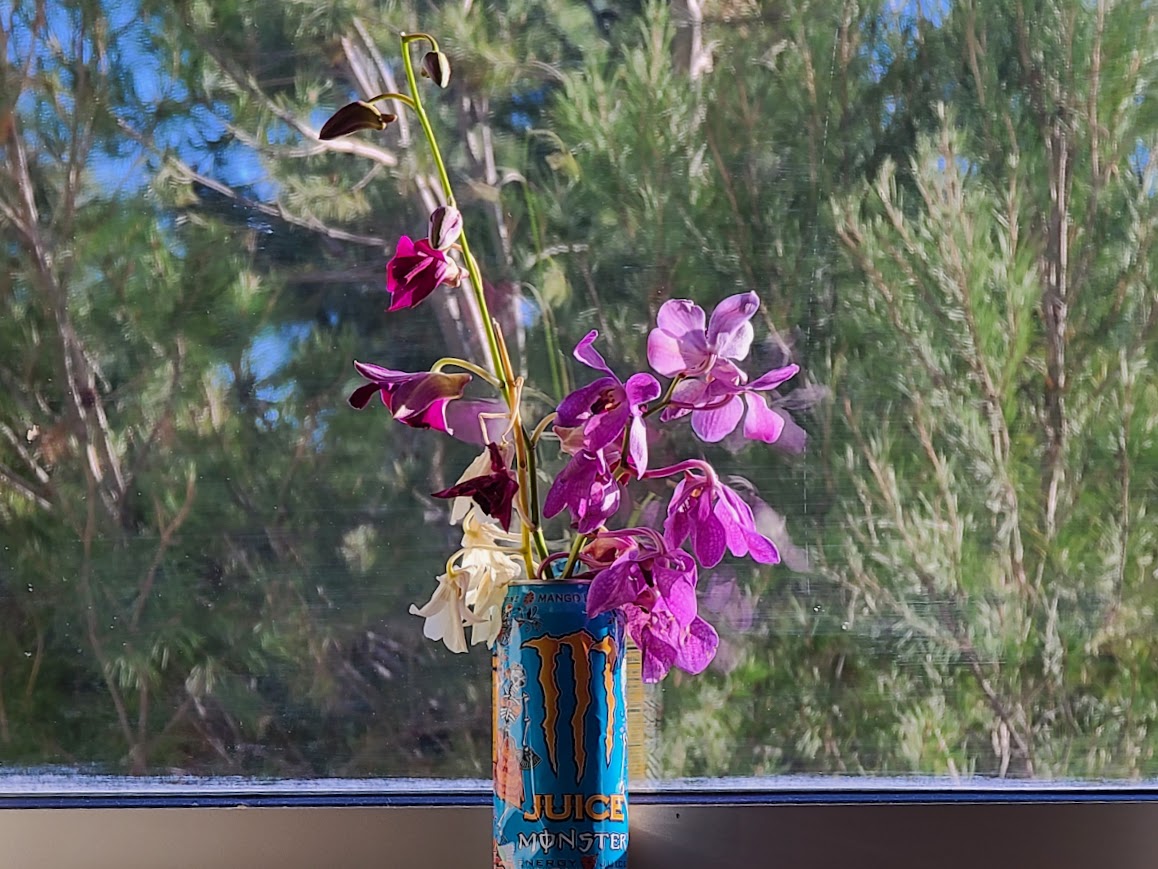
Good can bloom from Monsters.
Though I look fondly at the ridiculousness of sleep-deprived me now, I probably won't in a few weeks when I'm caught inside sleep debt again. I'm already two-and-a-half weeks out from the quarter ending, and I'm still sleeping 10-11 hours nightly.
But the good news is . . .
If you couldn't tell, my gratitude for my math friends is overflowing and is the reason why I created this article. So I'd like to give my thanks
To everyone who has shared in the joys and sorrows of learning math with me, thank you for making UCLA Math Sci feel like home!